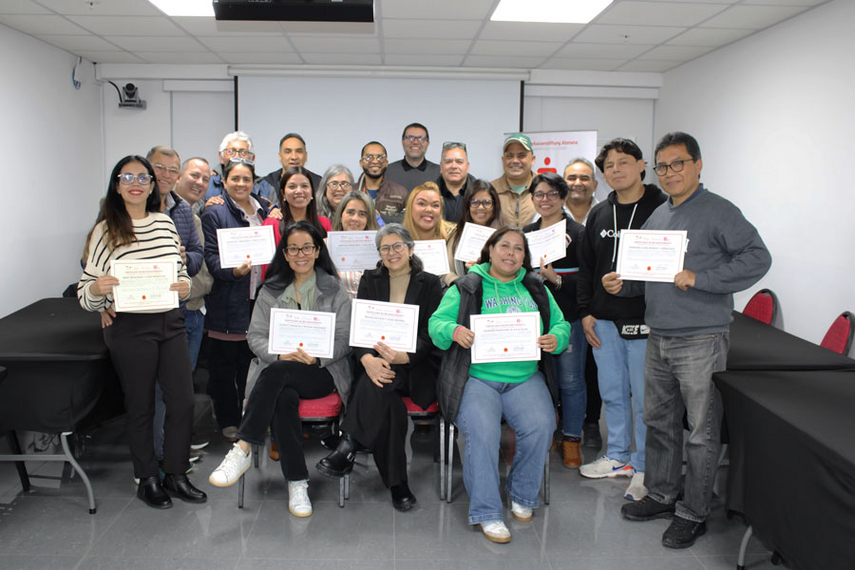
Successful implementation of educational and financial measures for refugees in Latin America

For five years, the German Sparkassenstiftung for international cooperation (DSIK) implemented a successful project for the economic and financial inclusion of refugees in Ecuador, Colombia and Peru. Financed by the Federal Ministry for Economic Cooperation and Development (BMZ) and supported by Berliner Sparkasse, the project opened up new economic prospects. The focus was on empowering people with refugee and migration experience and sustainably promoting their active role in local economic cycles.
The project work focused on financial education, entrepreneurial skills and improved access to needs-based financial services. A total of almost 4,000 people were reached, around 2,700 of whom took part in financial and entrepreneurial education measures. These included business games, further training for trainers and a financial coaching programme for couples. In addition, employees of financial institutions were trained to reduce existing barriers to accessing financial services. Digital learning and exchange formats via the Impulso Migrante platform complemented the project activities.

Another focus was on strengthening local partner organisations. A total of eleven non-governmental organisations received institutional support and 15 educational programmes on financial and economic inclusion were developed or adapted to the needs of the target groups. At the same time, the project collaborated with five financial institutions. Within this framework, nine financial products and internal processes were adapted or newly developed, giving more than 2,100 people access to formal financial services for the first time or once again.
The establishment and use of networks also contributed to the implementation of the project. Regional and national exchange formats promoted cooperation between relevant actors. The Impulso Migrante community now has over 1,000 members and facilitates the cross-border exchange of experiences, information and resources. In addition, scientific papers were produced that systematically document the project experiences.
The approaches and instruments developed in the project are anchored in the partner institutions and will continue to be used beyond the project period. In addition, key activities are being incorporated into the regional KKMU project, which supports micro, small and medium-sized enterprises, including entrepreneurs with refugee or migration experience.
Even though the regional project is now officially complete, DSIK remains active in Latin America. All information on current projects, such as the sustainable restructuring of the financial sector in Latin America or the promotion of technological innovation in Honduras, can be found here.